

Mangrove Charcoal Grades: How Size and Shape Affect Product Selection
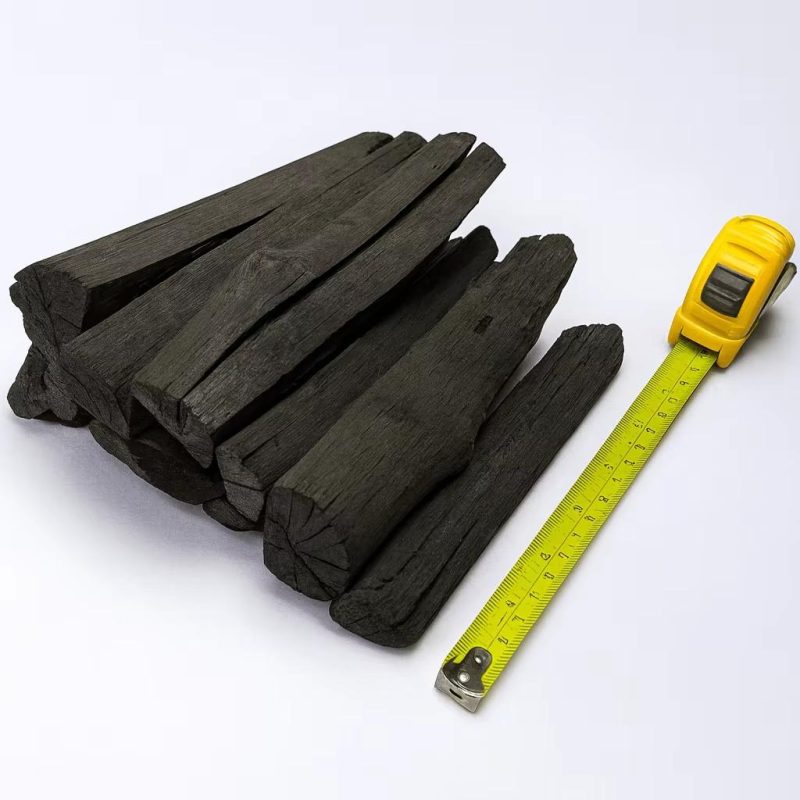
Mangrove charcoal products can differ in length, diameter, shape and physical integrity. ALT: Mangrove Charcoal Grades – mangrove charcoal sizes and shapes for wholesale buyers.
Mangrove Charcoal Grades are an important consideration for international charcoal importers, wholesale distributors and businesses sourcing charcoal for commercial barbecue markets.
Although mangrove charcoal is often described as one product category, the material can be supplied in several different shapes, lengths, diameters and physical grades.
Some buyers request long, relatively intact charcoal sticks. Others prefer medium-sized segments, smaller pieces, split charcoal or irregular lumps.
These differences influence product identification, packaging, distribution and commercial value.
For buyers comparing Mangrove Charcoal Grades for Export, understanding how suppliers classify their products is essential. Terms such as A1, A2, B3, Small, Medium and Large do not necessarily have identical meanings across manufacturers.
A product classified as premium by one company may follow a different set of physical specifications from a similarly named product supplied by another company.
Consequently, Mangrove Charcoal Grading should be based on measurable characteristics rather than grade names alone.
This guide explains common Mangrove Charcoal Sizes, physical shapes, sorting practices and export specifications to help international buyers make more informed purchasing decisions.
What Are Mangrove Charcoal Grades?
Mangrove Charcoal Grades are commercial classifications used to separate charcoal products according to physical characteristics.
Common grading criteria include piece length, diameter, shape, the percentage of intact pieces and the amount of broken material.
Some suppliers focus on producing elongated charcoal sticks, while others market mixed lump charcoal or shorter wood segments.
A published example comes from Thai supplier V.9 Charcoal, which classifies mangrove charcoal into A1, A2, B3, B4 and B5 categories.
According to its product specifications, A1 charcoal consists of longer sticks, while several B-grade products consist of charcoal lumps with different size ranges.
Other companies use their own systems.
For example, Vietnamese supplier Hasatu publishes charcoal products classified by Small, Medium and Large size ranges.
These examples show why grade names cannot be treated as universal standards.
The term A1 may describe physical appearance or dimensions rather than a laboratory-tested fuel performance level.
Therefore, buyers should distinguish Mangrove Charcoal Grades from chemical specifications such as fixed carbon, moisture and ash content.
A grade designation is commercially useful only when the buyer and supplier agree on what the designation means.
Mangrove Charcoal Size Chart: Comparing Commercial Size Ranges
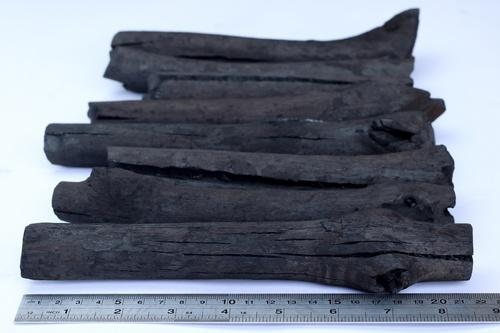
Length measurement is one method used to classify commercial mangrove charcoal. ALT: Mangrove Charcoal Size Chart – short, medium and long charcoal pieces.
A Mangrove Charcoal Size Chart helps buyers compare the physical dimensions of products offered by different suppliers.
However, no universal S, M and L grading chart applies to all mangrove charcoal.
Hasatu publishes one commercial classification based on piece length.
| Example grade | Published length | General description |
|---|---|---|
| Small (S) | 2–5 cm | Short charcoal segments |
| Medium (M) | 5–10 cm | Medium-length charcoal |
| Large (L) | 10–15 cm | Longer charcoal pieces |
| Long sticks | Contract-specific | Extended sticks with separately specified dimensions |
Illustrative commercial categories based on Hasatu’s published ranges. These are not internationally standardized grades or verified Vietargo product dimensions.
Another supplier, DaVieGo, publishes a different system combining length and diameter.
Its specifications describe Size S as approximately 2–4 cm in diameter and 5–10 cm in length, Size M as 3–6 cm in diameter and 10–20 cm in length, and Size L as 4–8 cm in diameter with lengths exceeding 20 cm.
The differences demonstrate why Mangrove Charcoal Sizes must be defined carefully.
An importer requesting Size M could receive products with substantially different dimensions depending on the supplier.
Length alone may also provide insufficient information.
Two charcoal sticks measuring 10 cm in length can have different diameters and masses.
For irregular lumps, it may be necessary to specify an agreed dimension or particle-size distribution method rather than assume every piece can be measured as a cylinder.
A reliable Mangrove Charcoal Size Chart should therefore identify what is being measured and which tolerances apply.
Mangrove Charcoal Shapes: The Main Product Forms
Mangrove Charcoal Shapes vary according to the original wood material and the condition of the finished charcoal.
Unlike manufactured briquettes, natural mangrove charcoal generally retains aspects of the wood’s original structure.
Several commercial shapes are commonly encountered.
Long Charcoal Sticks
Long sticks preserve the elongated shape of the carbonized wood.
They may have approximately cylindrical sections, irregular edges and visible surface cracks.
Length, diameter and physical integrity are common commercial grading criteria.
Short Round Pieces
Short pieces are segments of carbonized wood that retain a relatively round cross-section but have shorter lengths.
These products can be classified using fixed length ranges.
Split Mangrove Charcoal
Split charcoal includes pieces with angular or fractured surfaces.
Depending on the original material, split pieces may be irregular rather than approximately cylindrical.
Mangrove Lump Charcoal
Mangrove Lump Charcoal consists of irregular charcoal pieces that may vary substantially in length, width and shape.
Lump charcoal is not automatically inferior to long sticks. Its suitability depends on the buyer’s agreed specifications.
These Mangrove Charcoal Shapes should also be distinguished from manufactured hexagonal sawdust charcoal briquettes.
Natural charcoal sticks retain the structure of carbonized wood, while manufactured briquettes have been formed into defined shapes from processed carbonaceous materials.
Mangrove Charcoal Sorting: Why Physical Grading Matters
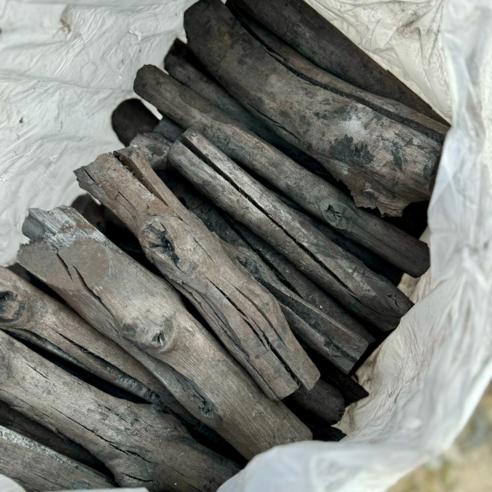
Sorting helps suppliers distinguish products by their physical specifications. ALT: Mangrove Charcoal Sorting – sorting natural charcoal by dimensions.
Mangrove Charcoal Sorting is the process of separating finished charcoal into commercially defined categories.
Its main purpose is to improve consistency between products sold under the same specification.
For example, a customer ordering 15–20 cm charcoal sticks may not consider a shipment acceptable if a substantial proportion consists of pieces shorter than 5 cm.
Another customer purchasing mixed lump charcoal may accept a wider size distribution.
The classification depends on the purchasing agreement.
Important sorting criteria can include length, diameter, physical shape, intact-piece percentage and acceptable fines.
For irregular charcoal, the method of measuring size also matters.
One buyer may define the longest dimension of a piece, while another may use a screening method.
These approaches can produce different results even when applied to the same shipment.
Consequently, Mangrove Charcoal Grading should not rely on visual appearance alone.
Clear sorting criteria make it easier to compare quotations, evaluate samples and determine whether delivered products meet the agreed grade.
They can also help exporters organize several product categories for different customer segments.
However, physical sorting does not change the charcoal’s original chemical composition.
It cannot substitute for laboratory testing of fuel quality.
Mangrove Lump Charcoal: Is Irregular Shape a Quality Problem?
Irregular lump charcoal can still meet commercial quality requirements. ALT: Mangrove Lump Charcoal – irregular mangrove charcoal for commercial distribution.
Mangrove Lump Charcoal is sometimes perceived as a lower commercial grade because its shape is less uniform than selected long sticks.
However, irregular shape alone does not establish lower fuel quality.
Chemical composition and physical dimensions are separate characteristics.
A shipment of irregular charcoal lumps may still meet moisture, ash and fixed carbon requirements applicable to the intended market.
The commercial value of the product depends on what the buyer needs.
For example, a distributor requiring visually consistent long sticks may assign greater value to intact pieces.
Another customer purchasing charcoal by an agreed mixed-size specification may place less importance on appearance.
V.9 Charcoal publishes several lump charcoal grades, including B3, B4 and B5, with different size ranges.
This shows that lump charcoal itself can be divided into several distinct commercial categories.
When assessing Mangrove Charcoal Grades, buyers should avoid confusing a supplier’s pricing hierarchy with a universal ranking of chemical performance.
An irregular piece is not automatically unsuitable, and a visually attractive long stick is not automatically a superior fuel.
The best assessment combines the intended application, physical specifications and verified charcoal quality.
How Size and Shape Affect Charcoal Performance
Mangrove Charcoal Sizes can influence the quantity of fuel contained in an individual piece.
A larger charcoal piece may contain more combustible material than a smaller piece of similar composition and density.
However, external dimensions alone cannot reliably predict burning duration.
Two pieces with the same length may have significantly different diameters.
A shorter, thicker piece can contain more material than a longer, thinner one.
Other factors include moisture content, density, chemical composition and the characteristics of the equipment in which the charcoal is used.
For Mangrove Charcoal for BBQ, these variables mean that product size should be evaluated alongside technical performance.
A supplier’s claim that a particular grade burns for several hours should identify the relevant product and testing conditions.
Without comparable measurements, burning-duration claims may not provide a reliable basis for comparing offers.
The same principle applies to heat output.
A long-stick grade is not automatically hotter than an irregular lump grade.
Shape is primarily a physical product characteristic, while heat performance requires a broader technical assessment.
Mangrove Charcoal Quality: More Than Size and Appearance
Charcoal quality assessment requires physical measurements and appropriate laboratory testing. ALT: Mangrove Charcoal Quality – charcoal specification testing and inspection.
Mangrove Charcoal Quality includes chemical and physical characteristics.
Important chemical parameters include fixed carbon, volatile matter, moisture content and ash content.
Physical characteristics include piece dimensions, shape, breakage and the proportion of undersized material.
ASTM D1762-84(2026) provides a method for determining moisture, volatile matter and ash in wood charcoal within its scope.
EN 1860-2:2023 establishes requirements for barbecue charcoal and barbecue charcoal briquettes.
For barbecue lump charcoal, the standard specifies at least 75% fixed carbon on a dry basis, no more than 8% ash on a dry basis and maximum total moisture of 8%.
The standard also addresses granulation.
For barbecue charcoal within its scope, the requirements include a maximum particle size of 150 mm and at least 80% of the total mass comprising pieces larger than 20 mm, together with additional size-distribution limits.
These requirements should not be confused with a commercial Mangrove Charcoal Size Chart.
A buyer may request a long-stick product that does not meet the standard’s general granulation limits. Such a product requires assessment against the actual contractual and market requirements rather than an assumption of automatic conformity.
Likewise, an A1 commercial designation does not certify compliance with EN 1860-2:2023.
Technical conformity must be established separately.
Mangrove Charcoal Grades for Export: Matching Products to Markets
Mangrove Charcoal Grades for Export should be selected according to the destination customer’s requirements.
Retail distributors may prioritize packaging dimensions, consistent product presentation and acceptable amounts of broken charcoal.
Wholesale buyers may focus on commercial weight, grade consistency and repeatable supply.
Specialty buyers may request particular lengths or shapes compatible with their intended products.
For Mangrove Charcoal for BBQ, grill designs can differ substantially.
One restaurant may use equipment suitable for a particular stick size, while another may require shorter pieces.
Therefore, no single mangrove charcoal grade is appropriate for every restaurant or market.
Importers should establish the intended application before selecting a grade.
A commercial classification is most useful when it connects a measurable product specification with an identified customer requirement.
It is less useful when the grade name is treated as a universal indicator of premium quality.
Breakage, Fines and Commercial Shipment Value
Charcoal packaging and transport can influence the proportion of intact pieces delivered to buyers. ALT: Mangrove Charcoal Grades for Export – mangrove charcoal packaging and intact product quality.
A major consideration in Mangrove Charcoal Grades for Export is how well the product retains its physical characteristics during transport.
The Food and Agriculture Organization explains that charcoal is friable and can break into smaller pieces and powder during handling and distribution.
This characteristic is commercially important for grades based on intact stick length.
A charcoal stick may meet the required dimensions at the production facility but break into shorter pieces during transport.
The total fuel mass may remain largely unchanged, yet the percentage of charcoal meeting the agreed commercial size can decrease.
For importers, this means that invoice weight and conforming product weight are not necessarily identical concepts.
Commercial contracts may therefore need to specify acceptable fines and breakage tolerances.
The sampling method and inspection stage should also be agreed.
An assessment performed before packing may produce different results from one performed after international transportation.
Packaging should be selected to help protect the product, while also meeting any applicable transport requirements.
Export Packaging and Maritime Transport Requirements
Export packaging for Mangrove Charcoal Grades serves both commercial and regulatory purposes.
Commercial packaging helps identify the product, supports handling and may reduce physical damage.
Regulatory transport requirements address separate matters.
From January 1, 2026, IMDG Code Amendment 42-24 became mandatory for international maritime transport.
Charcoal classified as UN1361, Class 4.2 is subject to relevant dangerous goods requirements.
Hapag-Lloyd has also published additional acceptance requirements for charcoal shipments originating in Vietnam.
Importers should therefore avoid assuming that a bag suitable for retail display automatically satisfies maritime cargo requirements.
The applicable packaging, documentation and carrier acceptance conditions should be confirmed by qualified dangerous goods professionals.
These obligations are separate from the commercial selection of charcoal sizes and shapes.
Responsible Raw Material Sourcing
Product grading does not establish the legality or environmental responsibility of raw material sourcing.
Mangrove forests provide significant ecological services, including coastal protection and wildlife habitats.
Because mangrove ecosystems can be vulnerable to poorly managed harvesting, buyers should consider the origin and legality of wood-based charcoal.
A product may be physically consistent and chemically suitable while lacking sufficient sourcing documentation.
Therefore, Mangrove Charcoal Quality and responsible raw material sourcing should be evaluated separately.
Exporters making sustainability or legality claims should be able to provide appropriate supporting information.
For international buyers, transparent documentation is more meaningful than broad statements that all natural mangrove charcoal is environmentally friendly.
What Should Buyers Include in Mangrove Charcoal Specifications?
A clear Mangrove Charcoal Specifications document helps avoid misunderstandings between buyers and suppliers.
It should identify the charcoal type, physical shape and agreed dimensional ranges.
If a grade includes whole sticks, split pieces or mixed lumps, the acceptable product forms should be stated.
Length, diameter and the method of measurement should be defined where relevant.
Buyers may also specify tolerances for undersized pieces, broken material and fines.
Technical quality information should be reviewed separately, including laboratory results appropriate to the product.
Packaging, net weight, commercial terms and the method of shipment inspection may also need to be addressed.
When comparing different suppliers, buyers should normalize the specifications before comparing prices.
Two quotations both describing A1 mangrove charcoal may represent different dimensions and different proportions of intact pieces.
Vietargo operates in Vietnam’s charcoal export industry. For products associated with Vietargo or other suppliers, buyers should rely on the confirmed specifications of the actual transaction rather than assume that industry grade names have one fixed meaning.
Conclusion
Mangrove Charcoal Grades are commercial categories that help distinguish mangrove charcoal by size, shape and physical integrity.
Common product forms include long sticks, short round pieces, split charcoal and irregular lumps.
However, grading terms such as A1, A2, B3, S, M and L are not universally standardized.
For importers, a useful Mangrove Charcoal Size Chart must be supported by clear measurements, acceptable tolerances and agreed inspection criteria.
Mangrove Charcoal Sorting can improve consistency within commercial product categories, but chemical quality and regulatory compliance still require separate evaluation.
Ultimately, the most appropriate Mangrove Charcoal Grades for Export are those that match the buyer’s required dimensions, technical specifications, packaging expectations and destination-market needs.
————————————————————————————————————————————————————————————————————————————-
VIETARGO – THE BEST CHARCOAL OF THE WORLD TO YOUR SHELF
Website : https://vietargo.com/
Facebook : Vietargo
địa chỉ : 10 Nguyen Hien Street, 91B Residential Area, Can Tho, Vietnam
☎: 0939364888