

Restaurant Charcoal Demand: What Matters to Foodservice Buyers?
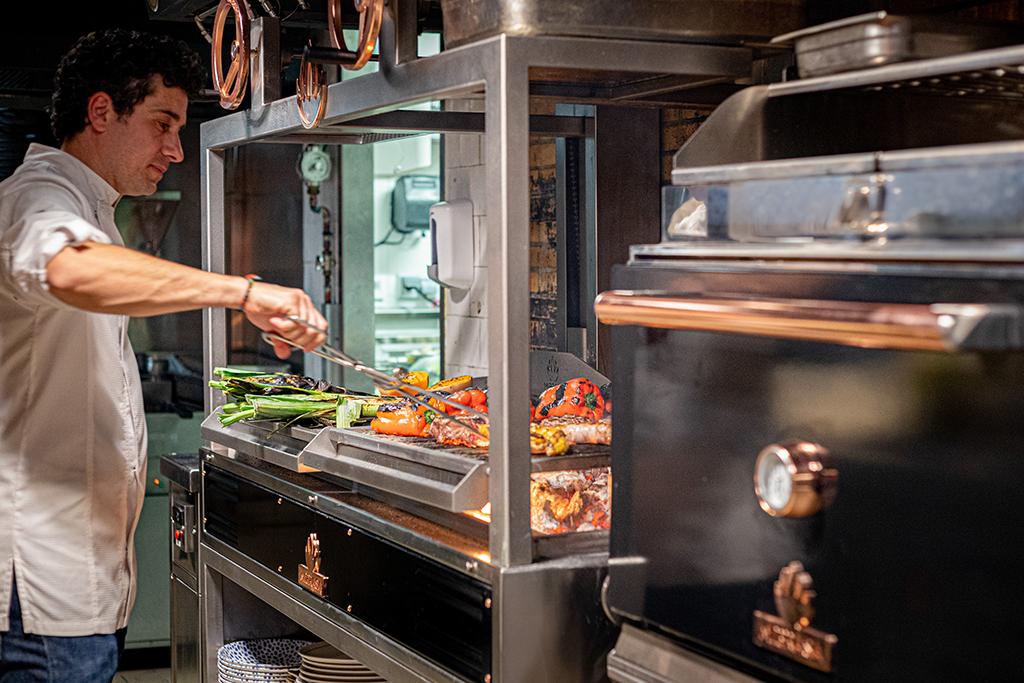
Commercial charcoal grills are used in different restaurant concepts and foodservice operations. ALT: Restaurant Charcoal Demand – commercial charcoal grilling in professional restaurants.
Restaurant Charcoal Demand is an important consideration for charcoal exporters, wholesale distributors, international importers and businesses supplying the foodservice industry. Unlike occasional household barbecue users, commercial kitchens may require charcoal products that support recurring operations, consistent product specifications and reliable purchasing schedules.
For restaurant buyers, charcoal is not simply a fuel purchased at the lowest available price. Its characteristics can influence purchasing budgets, equipment compatibility, ash management, stock planning and the consistency of daily operations.
This is why choosing Charcoal for Restaurants involves several considerations beyond the cost per kilogram.
Professional buyers may examine product dimensions, moisture, ash content, fixed carbon, physical integrity and the reliability of deliveries. They may also need suppliers that can provide documented specifications and consistent commercial packaging.
For importers purchasing Wholesale Restaurant Charcoal, these requirements influence product selection, supplier evaluation and the structure of distribution agreements.
However, restaurant charcoal requirements are not identical across every foodservice operation. A steakhouse, Japanese yakitori restaurant and Korean barbecue chain may operate different grilling systems.
Understanding Restaurant Charcoal Demand therefore requires examining the practical needs of the customer rather than assuming that one charcoal product is suitable for every restaurant.
How Restaurant Charcoal Demand Differs From Household BBQ Demand
Household charcoal purchases are often associated with occasional grilling activities.
Restaurant purchases may involve ongoing demand, recurring inventory requirements and scheduled deliveries.
This difference makes consistency particularly important.
A restaurant that relies on charcoal grilling needs to consider whether the fuel is compatible with its equipment and whether future deliveries are likely to match the specifications of previously accepted products.
A substantial change in charcoal dimensions, breakage or moisture may affect the way the product fits within established operating requirements.
Consequently, Restaurant Charcoal Demand is not only about the quantity of charcoal purchased.
It also concerns the reliability of the fuel supplied over time.
Different restaurant concepts may have different purchasing priorities.
Japanese robata and yakitori establishments may place importance on specific shapes and fuel characteristics compatible with their cooking equipment.
Commercial barbecue restaurants may prioritize an appropriate balance between heat duration and product consistency.
Restaurants using specialized enclosed charcoal ovens may need to follow manufacturer-specific fuel requirements.
For this reason, Best Charcoal for Restaurants should be understood as an application-specific decision, not a universal product ranking.
What Does Restaurant Grade Charcoal Mean?
Commercial charcoal products are supplied in different dimensions and physical forms. ALT: Restaurant Grade Charcoal – natural hardwood charcoal and commercial charcoal briquettes.
Restaurant Grade Charcoal is a commercial term often used to describe charcoal intended for professional foodservice applications.
However, it is not a globally standardized product grade with one universally accepted set of technical requirements.
One manufacturer may use the term to describe large charcoal pieces, while another may associate it with dense briquettes or products advertised for extended burning duration.
Therefore, buyers should not assume that a product labeled Restaurant Grade Charcoal automatically meets a recognized technical standard.
For European barbecue charcoal markets, EN 1860-2:2023 provides requirements and test methods for barbecue charcoal and barbecue charcoal briquettes.
The standard distinguishes the two product categories and specifies parameters including fixed carbon, ash content and moisture.
For example, its requirements for barbecue lump charcoal include at least 75% fixed carbon on a dry basis, a maximum of 8% ash on a dry basis and maximum total moisture of 8%.
Barbecue charcoal briquettes have different applicable fixed carbon and ash limits.
These specifications provide useful reference points, but they do not establish a separate universal restaurant-grade classification.
Commercial buyers should define the parameters appropriate for their intended product and market rather than rely only on promotional terminology.
Restaurant Charcoal Quality: The Specifications That Matter
Restaurant Charcoal Quality involves chemical and physical characteristics that can be measured and compared.
Important parameters typically include fixed carbon, moisture content, ash content, volatile matter, piece dimensions and the proportion of small fragments.
The Food and Agriculture Organization (FAO) identifies several of these characteristics as relevant to commercial charcoal quality.
FAO also notes that charcoal can absorb moisture and suffer physical breakage during handling and distribution.
For foodservice buyers, these factors may influence different aspects of product evaluation.
Moisture content provides information about the amount of water present in the fuel.
Ash content represents inorganic residue remaining after the specified laboratory analysis.
Fixed carbon and volatile matter describe important aspects of the fuel’s chemical composition.
Physical dimensions and the percentage of fines indicate whether the product matches the agreed commercial specification.
However, no individual parameter can guarantee a particular cooking temperature or burning duration in every restaurant.
Product performance also depends on the equipment and its operating conditions.
When buying Wholesale Restaurant Charcoal, importers should request documented specifications and confirm the testing methods used.
Clear definitions reduce the possibility of disputes about whether delivered goods match the agreed product.
Long Burning Restaurant Charcoal: Why Burn Time Matters
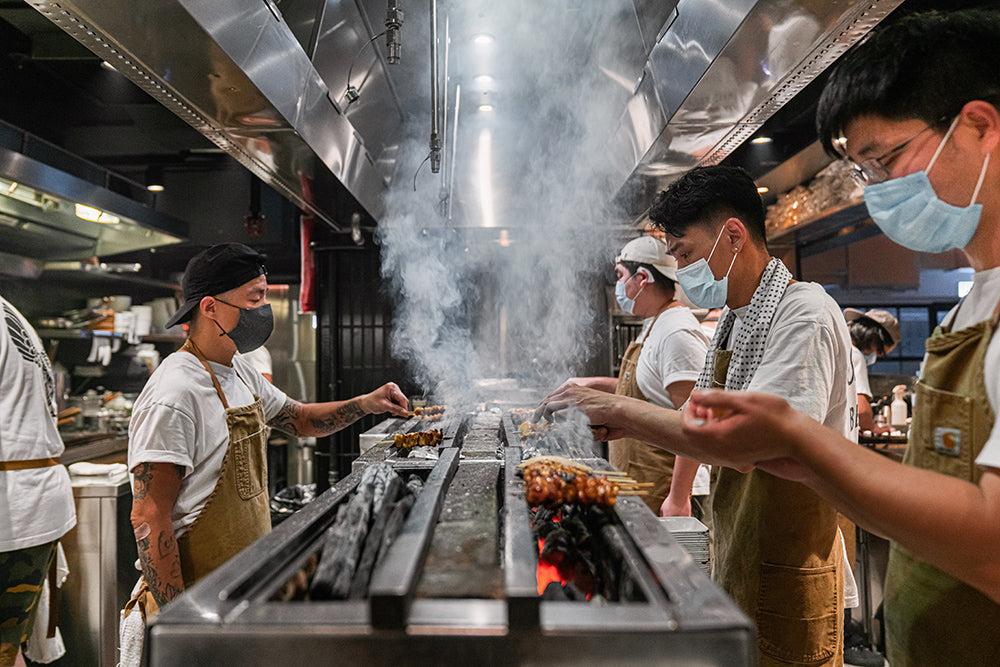
Different foodservice equipment may require different charcoal burning characteristics. ALT: Long Burning Restaurant Charcoal – professional charcoal grilling station.
Long Burning Restaurant Charcoal is frequently marketed to commercial kitchens that require sustained heat during extended operating periods.
The potential value is understandable.
Restaurants may prefer fuel that remains suitable for their intended operating schedule without creating unnecessary uncertainty about consumption.
However, charcoal burning duration is not a fixed property that can be evaluated independently of testing conditions.
The same charcoal may behave differently depending on grill construction, airflow, fuel mass and other variables.
Piece dimensions, density, moisture and physical composition can also affect performance.
Therefore, a product marketed as burning for four or five hours should be evaluated alongside the conditions under which that result was measured.
For professional buyers, a burning-time claim without clear supporting information has limited comparative value.
It is also important to distinguish burning duration from useful heat delivery.
A product may continue to contain partially burned material without necessarily maintaining the heat characteristics required by a particular restaurant.
For this reason, Long Burning Restaurant Charcoal is not automatically the Best Charcoal for Restaurants.
The appropriate choice depends on the equipment, service requirements and the performance characteristics the buyer values.
Commercial BBQ Charcoal: Lump Charcoal and Manufactured Briquettes
Commercial BBQ Charcoal can include natural hardwood lump charcoal and several forms of manufactured charcoal briquettes.
These product categories differ in structure and manufacturing characteristics.
Natural lump charcoal is produced from carbonized wood and typically retains irregular shapes.
Manufactured briquettes are formed into defined dimensions and may be produced from different carbonized biomass materials.
Examples include coconut shell charcoal briquettes and carbonized sawdust briquettes.
Some products are manufactured in pillow shapes, while others may be cylindrical or hexagonal.
The appropriate form depends on the intended application and equipment.
Uniform dimensions can be useful when buyers require consistent physical specifications.
However, this does not mean all briquettes deliver identical burning performance.
Raw material composition, density, binders where applicable and manufacturing consistency may influence fuel characteristics.
Similarly, natural lump charcoal products can vary significantly between suppliers.
For buyers evaluating Charcoal for Restaurants, the correct comparison is between specific products and their documented specifications.
Broad assumptions about one charcoal category being universally superior can lead to unsuitable purchasing decisions.
Why Ash Content and Charcoal Fines Matter
Two practical aspects of Restaurant Charcoal Quality are ash content and the percentage of broken or undersized material.
Ash content is a laboratory measurement of the inorganic residue remaining after a specified test.
Different charcoal products can have different ash percentages depending on their raw materials and composition.
Although laboratory ash results are relevant, they should not be confused with a direct measurement of all waste generated during restaurant operation.
Actual ash management depends on the equipment and the quantity of fuel used.
Charcoal fines create a different commercial issue.
Charcoal is a relatively friable material, meaning that pieces may fracture during transport and handling.
FAO identifies breakage and the formation of smaller fragments as important considerations in charcoal distribution.
For importers purchasing Bulk Charcoal for Restaurants, a shipment containing excessive broken material may offer less product within the agreed size specification.
This can affect the commercial value of the delivered goods.
Therefore, buyers should consider packaging quality, handling conditions and the percentage of fines when evaluating a supplier.
A product specification should clearly define acceptable piece sizes and any relevant tolerance for fragments.
Foodservice Charcoal Supply: Why Reliability Matters
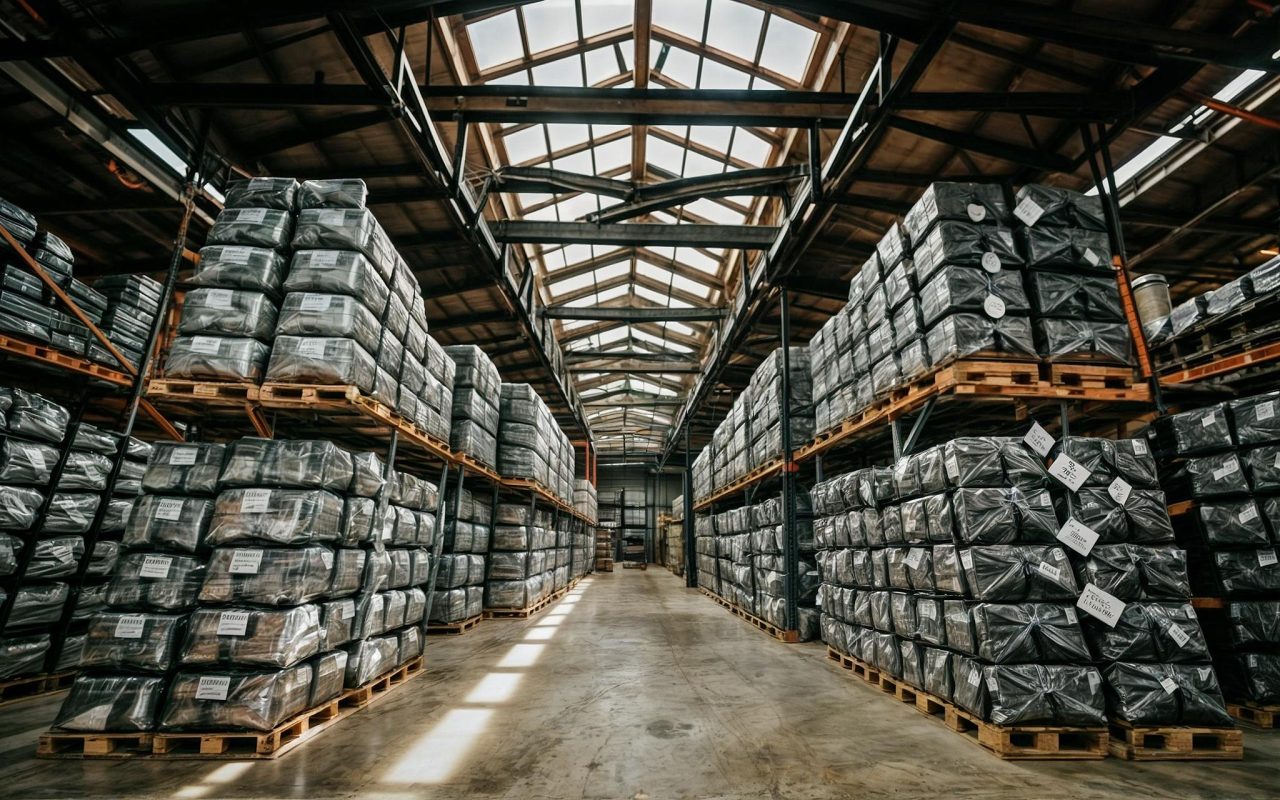
Reliable inventory and distribution are important to wholesale restaurant charcoal purchasing. ALT: Foodservice Charcoal Supply – restaurant charcoal distribution warehouse.
Foodservice Charcoal Supply involves more than obtaining a suitable product at the time of an initial order.
For distributors and restaurant chains, reliable replenishment is a significant commercial consideration.
A product may meet quality expectations, but interruptions in availability can create difficulties for businesses with recurring customer demand.
Importers may need to coordinate overseas production, shipping schedules, local warehousing and downstream deliveries.
Each stage introduces uncertainty that should be considered in purchasing plans.
This is why Restaurant Charcoal Suppliers should be evaluated not only on product quality but also on their ability to fulfill agreed commercial commitments.
Relevant information may include production capacity, lead times, packaging options and the consistency of previous deliveries.
For businesses serving multiple restaurant locations, dependable supply can be as important as the specifications of the charcoal itself.
A lower initial purchase price may offer limited value if the buyer repeatedly experiences product shortages or unexpected changes in shipment timing.
Consequently, Foodservice Charcoal Supply is best understood as a combined product-quality and supply-chain management issue.
Wholesale Restaurant Charcoal: Price per Kilogram vs Total Value
Wholesale Restaurant Charcoal is often compared using a price per kilogram or price per metric ton.
These figures are important, but they do not automatically show the total commercial value of a product.
A lower-priced shipment may contain a higher proportion of broken material or greater variation between production batches.
Conversely, a higher-priced product does not necessarily offer better value unless its characteristics meet the customer’s requirements.
For commercial buyers, a more useful comparison may consider the cost per unit of product meeting the agreed specification.
For example, consider two hypothetical charcoal offers.
Product A costs US$600 per metric ton, with 5% of the material falling outside the specified commercial size range.
Product B costs US$570 per metric ton, with 12% falling outside that range.
Assuming, solely for illustration, that all out-of-specification material has no commercial value, the effective cost of conforming product would be approximately US$632 per ton for A and US$648 for B.
These are hypothetical values, not current market prices or representative industry defect rates.
The example demonstrates why Restaurant Charcoal Demand should be evaluated using usable product quality rather than invoice price alone.
For a restaurant, cost per operating session may also be more informative than price per bag, provided the comparison uses equivalent equipment and conditions.
How to Evaluate Restaurant Charcoal Suppliers
When selecting Restaurant Charcoal Suppliers, international buyers should consider product documentation, manufacturing capabilities and commercial reliability.
Important information includes raw material type, charcoal specifications, dimensions, packaging, production consistency and supporting quality records.
For buyers developing their own brands, OEM or private-label packaging capabilities may be additional considerations.
However, attractive packaging is not a substitute for verified product quality.
A supplier that provides a satisfactory initial sample should still be able to demonstrate appropriate controls for subsequent production and shipments.
This is particularly relevant when purchasing Bulk Charcoal for Restaurants, where commercial orders may be substantially larger than the initial sample quantity.
Vietargo operates in Vietnam’s charcoal export industry.
When assessing products associated with Vietargo or any other supplier, buyers should review the confirmed technical specifications and documentation relevant to the actual transaction.
Claims about heat, burning duration or ash content should be supported by appropriate evidence.
The objective is to select a supplier whose products and capabilities align with the customer’s requirements.
International Shipping Requirements for Restaurant Charcoal
For importers purchasing Commercial BBQ Charcoal from overseas, shipping requirements can affect cost and lead time.
Under the International Maritime Dangerous Goods Code, charcoal classified as UN1361, Class 4.2 is subject to dangerous goods transport requirements.
IMDG Code Amendment 42-24 became mandatory on January 1, 2026.
Hapag-Lloyd also confirmed that charcoal must be declared under the applicable dangerous goods classification and that additional carrier-related charges may apply.
For foodservice buyers, these requirements can influence the overall landed cost of imported charcoal.
They may also affect cargo acceptance, documentation and shipping schedules.
Not every carrier has identical commercial acceptance policies, so importers should obtain shipment-specific confirmation from qualified logistics providers.
Consequently, Foodservice Charcoal Supply planning should account for both production lead times and relevant international transportation requirements.
Charcoal Safety in Commercial Kitchens
The suitability of Charcoal for Restaurants must also be considered in relation to commercial kitchen safety.
The United Kingdom’s Health and Safety Executive (HSE) has published guidance specifically addressing carbon monoxide exposure from solid-fuel appliances in commercial kitchens.
The guidance covers equipment such as charcoal grills, tandoori ovens and wood-fired cooking systems.
Carbon monoxide is a serious hazard associated with charcoal combustion, and a product marketed as low smoke does not eliminate this risk.
Restaurant operators need to follow applicable requirements for equipment, ventilation and worker protection.
Fuel selection should also remain consistent with the grill manufacturer’s approved specifications.
The performance or price of charcoal should never be considered a substitute for proper commercial kitchen safety management.
Restaurant Charcoal Demand: What Buyers Should Watch in 2026
Several commercial factors remain relevant to Restaurant Charcoal Demand during 2026.
These include consistent product specifications, reliable replenishment, transparent quality documentation and the full cost of imported charcoal.
However, the sources reviewed for this article do not establish a verified global growth rate for restaurant-specific charcoal demand in 2026.
Therefore, it would be inappropriate to claim that worldwide restaurant charcoal purchases have increased by a particular percentage without a suitable dataset.
The more useful assessment is to identify the requirements that buyers can directly evaluate.
For Vietnamese charcoal exporters, understanding different restaurant applications and supplying clear technical information can help improve the relevance of product offers.
For importers, comparing supplier reliability with documented charcoal characteristics provides a stronger basis for procurement than relying on broad promotional claims.
Conclusion
Restaurant Charcoal Demand reflects the requirements of professional foodservice buyers, not simply consumer interest in barbecue fuel.
Important considerations include Restaurant Charcoal Quality, appropriate product dimensions, burning characteristics, ash content, supply consistency and total purchasing costs.
Businesses choosing Restaurant Charcoal Suppliers should evaluate both the technical specifications of the fuel and the supplier’s capacity to meet recurring commercial requirements.
For bulk importers, logistics compliance and delivery reliability also influence overall product value.
The Best Charcoal for Restaurants is not necessarily the most expensive product or the charcoal with the longest advertised burning duration. It is the product that consistently meets the restaurant’s equipment requirements, quality expectations, operational needs and commercial budget.
Sources & References
VIETARGO – THE BEST CHARCOAL OF THE WORLD TO YOUR SHELF
Website : https://vietargo.com/
Facebook : Vietargo
địa chỉ : 10 Nguyen Hien Street, 91B Residential Area, Can Tho, Vietnam
☎: 0939364888